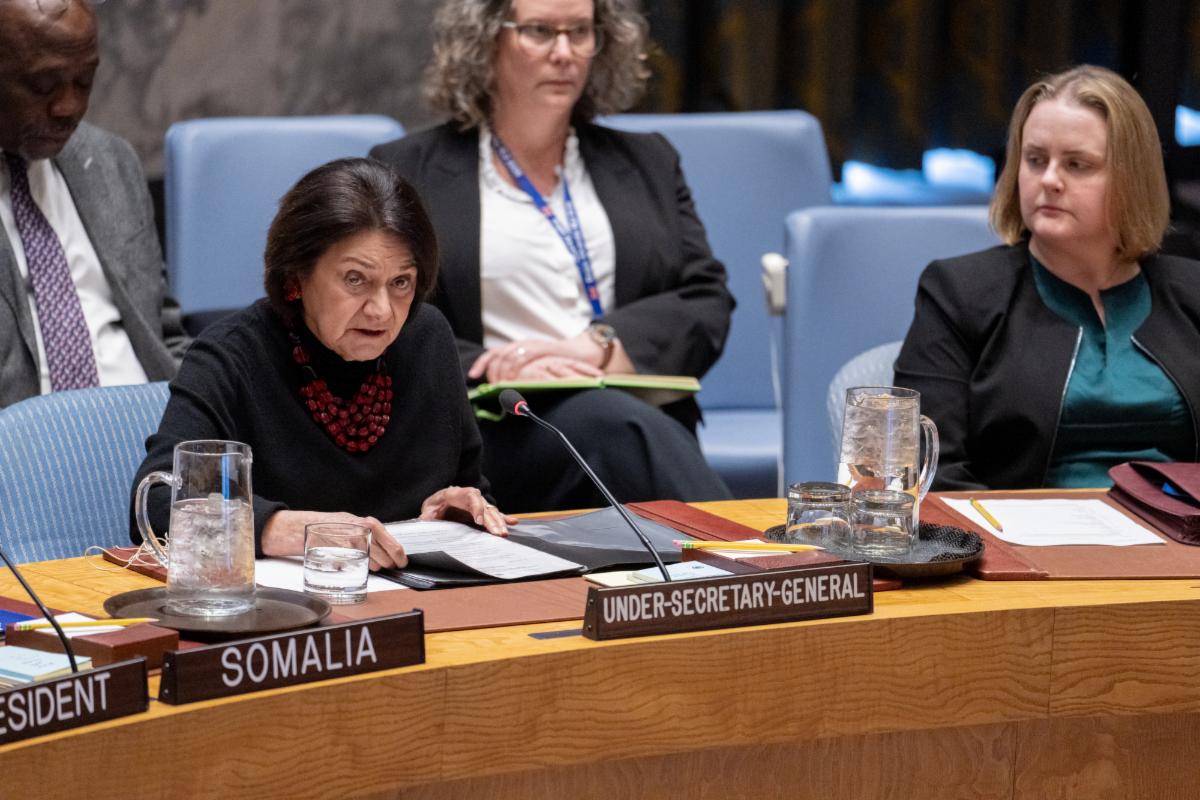
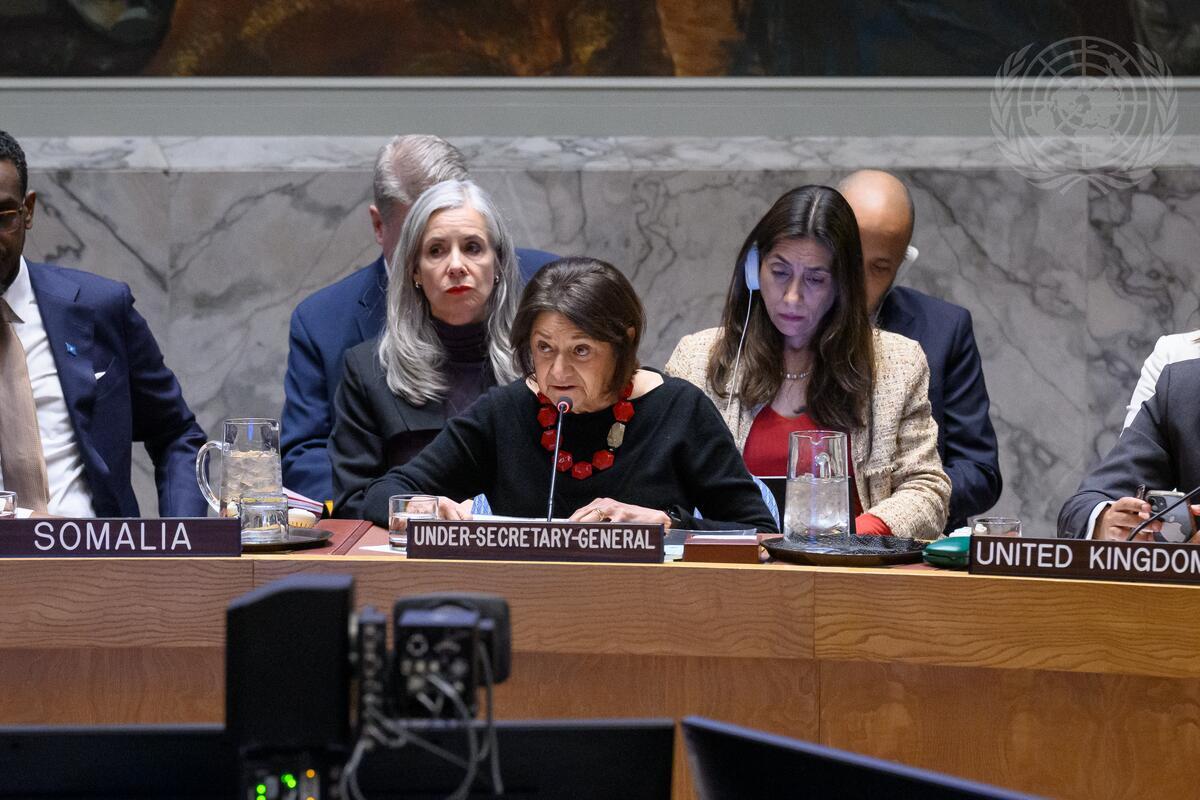
Under-Secretary-General Rosemary A. DiCarlo's
Remarks to the Security Council on Ukraine
New York, 12 January 2026
Mr. President,
The start of the New Year has brought no peace or even respite to Ukraine, but renewed fighting and devastation.
Large-scale aerial assaults by the Russian Federation against civilians and critical civilian infrastructure across the country have resulted in horrific levels of destruction and suffering.
As temperatures plummet far below freezing, the Russian Federation has intensified its systematic attacks targeting Ukraine’s energy infrastructure.
The strikes have killed and injured scores of civilians and deprived millions of Ukrainians of electricity, heating and water for prolonged periods.
The impact of these attacks is felt hardest by the most vulnerable: the elderly, children, and persons with limited mobility.
They follow a well-established and deeply troubling pattern: attacks escalate when weather conditions worsen and people’s need for heating becomes most acute.
In one of the most recent large-scale barrages, overnight between 8 and 9 January, the Russian Federation reportedly launched 242 drones and 36 missiles against Ukraine.
In Kyiv, at least four people were reportedly killed and 25 others injured. A paramedic rushing to provide emergency medical care was among those killed, reportedly by a so-called “double-tap” strike.
Energy facilities and multiple residential buildings were damaged, leaving nearly half of the city and hundreds of thousands of residents without heating. The Embassy of Qatar was also damaged.
That same day, areas of the western Lviv region, near the Polish border, were reportedly targeted by a Russian intermediate-range ballistic missile, the so-called “Oreshnik”.
This would be the second time the potentially devastating weapon has been fired at Ukraine since 2024.
The Oreshnik system is believed to be capable of carrying nuclear weapons, which has heightened concern over its deployment.
According to Ukrainian authorities, this strike damaged gas distribution pipelines, raising additional concerns about risks to critical civilian infrastructure.
Also on 8 January, two foreign-flagged civilian vessels were hit by Russian drones in the Odesa region.
On 7 January, Russian strikes in the Dnipropetrovsk and Zaporizhzhia regions reportedly left more than one million people without running water or heating.
In Kryvyi Rih, 17 people, including children, were reportedly injured when missiles and drones hit residential buildings and other civilian infrastructure.
And in the Odesa region, two people were reportedly killed and eight others injured in an attack on two ports. Cooking oil storage facilities and containers were damaged.
Odesa was hit again yesterday. This was the latest in a highly concerning escalation of strikes targeting Ukraine’s port infrastructure and commercial shipping.
In recent weeks, civilian casualties and extensive damage to critical infrastructure have also been reported in Kherson, Donetsk, Kharkiv and Sumy regions.
In total, since the start of the Russian Federation’s full-scale invasion of Ukraine in February 2022, the Office of the High Commissioner for Human Rights (OHCHR) has verified that at least 14,999 civilians have been killed, including 763 children, and 40,601 civilians injured, including 2,486 children. The actual figures are likely higher. OHCHR’s Monitoring Mission in Ukraine has just reported that 2025 was the deadliest year for civilians since 2022.
Mr. President,
Inside the Russian Federation, local authorities continue to report civilian casualties and damage to civilian infrastructure resulting from alleged Ukrainian strikes.
We are seeing additional reports of escalating cross-border attacks on Russia’s oil and energy facilities, some of which reportedly resulted in civilian casualties and damage to civilian and residential facilities.
In Belgorod oblast, local authorities reported that 600,000 residents were left without electricity, heating and water after a Ukrainian strike on 9 January.
The authorities also reported the use of drones targeting Kursk, Bryansk and Belgorod regions on 10 January, which left one person killed and at least three other people injured.
Due to lack of access and limited public information, the United Nations is not in a position to verify these reports.
Mr. President,
We reiterate the Secretary-General’s strong condemnation of all attacks against civilians and civilian infrastructure. Such attacks violate international humanitarian law.
No matter where they occur, they are unacceptable, unjustifiable, and must stop immediately.
Mr. President,
As hostilities intensify, the situation at Ukraine’s nuclear sites remains extremely precarious.
On the night of 3 January, Europe’s largest nuclear power plant, the Zaporizhzhia Nuclear Power Plant (ZNPP), temporarily occupied by the Russian Federation, lost power from one of its high-voltage lines due to hostilities.
Over past week, the team of the International Atomic Energy Agency (IAEA) at the site has reported a significant increase in military activity in the areas surrounding the plant, including explosions heard close to the facility.
These events are exceedingly alarming. The IAEA continues its efforts to establish temporary ceasefire zones in the areas around the plant to allow for essential repair work to ensure its safe and secure functioning.
We urge both the Russian Federation and Ukraine to engage constructively with the IAEA and to immediately cease any military activities near the plant in order to reduce the risk of a catastrophic accident.
Mr. President,
In just over a month, we will mark four years since the start of the Russian Federation’s full-scale invasion of Ukraine.
The war has brought untold suffering to the Ukrainian people, killed an unimaginable number of young men of both countries, caused global economic dislocation and sown instability in the region and beyond.
The damage it has done to the international system is still being measured. The war should never have started. It must stop.
We commend the efforts of the United States and all others concerned working towards peace.
We urge all involved to sustain this vital work, including through concrete steps to deescalate, stop the ongoing attacks impacting civilians in Ukraine and in the Russian Federation, and establish clear parameters to end this devastating conflict.
We reaffirm the Secretary-General’s repeated calls for an immediate, full and unconditional ceasefire as a first step towards a just, lasting and comprehensive peace grounded in respect for international law and the principles of the United Nations Charter.
Any peace in Ukraine must fully uphold the sovereignty, independence and territorial integrity of Ukraine, within its internationally recognized borders.
The United Nations remains ready to support all meaningful efforts toward this end.
Thank you, Mr. President.