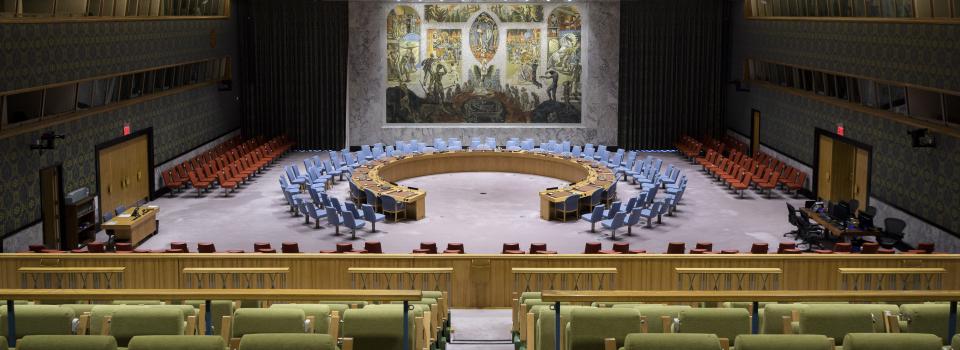
Under-Secretary-General Rosemary A. DiCarlo's
Remarks to the Security Council on the Middle East, including the Palestinian question.
New York, 18 February 2026
Thank you, Madam President.
This is a pivotal moment in the Middle East.
After years of devastating conflict and immense human suffering, there is an opening, one that could allow the region to move in a different direction. But that opening is neither assured nor indefinite.
The decisions taken in the coming weeks – by the parties and by members of this Council – will determine whether it is sustained.
Our collective efforts must now consolidate the ceasefire in Gaza and alleviate the suffering of the population.
We need concrete progress toward stabilization and recovery, consistent with international law, to lay the foundations for lasting peace.
The Board of Peace meeting in Washington, D.C., tomorrow is an important step.
We have a responsibility to work collectively to implement Phase II of the Gaza ceasefire and advance efforts toward a credible political path leading to a negotiated two-State solution.
This must include the demilitarization of the Strip, the decommissioning of weapons held by Hamas and other Palestinian armed groups, and the establishment of security arrangements that can facilitate the important transitional governance tasks of the National Committee for the Administration of Gaza.
In parallel, the entry of assistance into Gaza must increase significantly. This is essential for an inclusive, Palestinian-led recovery and reconstruction.
Madam President,
Encouraging progress has been made since the ceasefire came into effect last October in aid access and delivery.
Still, the vast majority of Gaza’s population remains displaced and continues to endure extremely harsh living conditions.
Humanitarian operations in Gaza have continued amid severe constraints. Scaled-up entry of shelter materials, educational supplies, and medical equipment, among other items, is urgently required.
The UN and its partners are expanding efforts to stabilize and rehabilitate essential systems and services as a bridge for longer-term recovery.
The opening of the Rafah crossing to pedestrian movement in both directions on 2 February was a welcome development.
The UN team on the ground is working closely with local and international stakeholders to promote a safe, dignified environment at the crossing and enable those in need to access medical assistance.
The UN supported the medical evacuation of many patients and received hundreds of returnees. Thousands still urgently require treatment unavailable in Gaza.
We remain committed to supporting the implementation of Security Council resolution 2803 and all relevant resolutions.
Madam President,
Despite the ceasefire, Gaza is still not at peace.
In recent weeks, the Israeli military intensified strikes across Gaza, hitting densely populated areas and killing dozens of Palestinians.
Air strikes were particularly heavy on 31 January and in early February.
Armed exchanges between Palestinian armed groups and Israeli soldiers have also continued.
In the occupied West Bank, meanwhile, the situation is deteriorating rapidly.
There, Israeli forces continued large-scale operations across the West Bank, frequently involving live fire and raising serious concerns about the use of lethal force.
Widespread raids have been accompanied by home takeovers, mass detentions, movement restrictions, and repeated displacement of Palestinian families, particularly in the north.
Attacks by Palestinians against Israelis, and confrontations between Palestinians and Israeli security forces, have also continued.
Israeli authorities also expanded operations in areas around Jerusalem and extended their operations in the northern West Bank.
These developments unfolded alongside continued settlement expansion, rising settler violence, and accelerated demolitions and evictions in East Jerusalem.
We are witnessing the gradual de facto annexation of the West Bank, as unilateral Israeli steps steadily transform the landscape.
I echo the Secretary-General’s grave concern regarding the Israeli security cabinet’s reported decision to authorize a series of enforcement measures and transfer of authorities in Areas A and B of the occupied West Bank.
If implemented, these measures will constitute a dangerous expansion of Israeli civil authority in the occupied West Bank, including in sensitive areas like Hebron.
The moves could lead to settlement expansion by removing bureaucratic barriers and easing land purchases and building permits.
I reiterate the Secretary-General's condemnation of the Israeli government’s 15 February decision to resume land registration procedures in Area C of the occupied West Bank.
The decision threatens to dispossess Palestinians of their property and expand Israeli control over land in the area.
Israel should immediately reverse these measures.
All Israeli settlements in the occupied West Bank, including East Jerusalem, and their associated regime and infrastructure, have no legal validity. They violate international law and UN resolutions.
Madam President,
Continued unilateral Israeli measures to withhold clearance revenues have deepened a persistent fiscal crisis for the Palestinian Authority.
This has led to partial salary payments for civil servants, severe cuts to basic services, and growing arrears and debt to the private sector and financial institutions.
Correspondent banking agreements, essential for the Palestinian economy, were renewed on 12 February for an additional two weeks.
A long-term extension, alongside renewed technical discussions between Israeli and Palestinian financial regulators, is critical for financial stability and for enabling large-scale recovery in Gaza, in line with Resolution 2803.
Madam President,
Allow me to conclude by stressing that at this fragile juncture for the region, we cannot afford half measures.
The US-led Comprehensive Plan must be implemented fully, alongside urgent action to de-escalate and reverse the dangerous trajectory in the occupied West Bank.
At the same time, we must seize this opportunity to restore a credible political horizon - one that leads to a lasting peace in Gaza, brings an end to the occupation and realizes a two-State solution in line with international law and relevant United Nations resolutions.
The United Nations remains steadfast in our commitment to that goal and to supporting Palestinians and Israelis in achieving it.
Thank you.