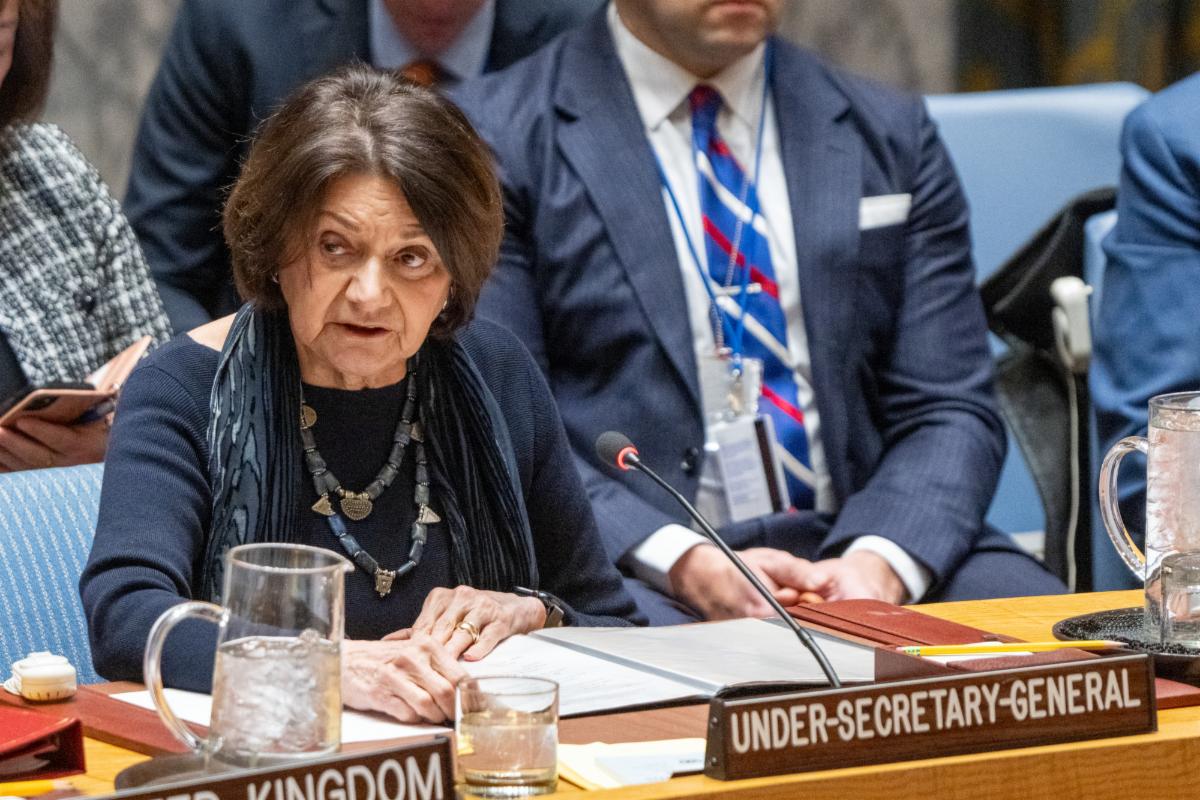
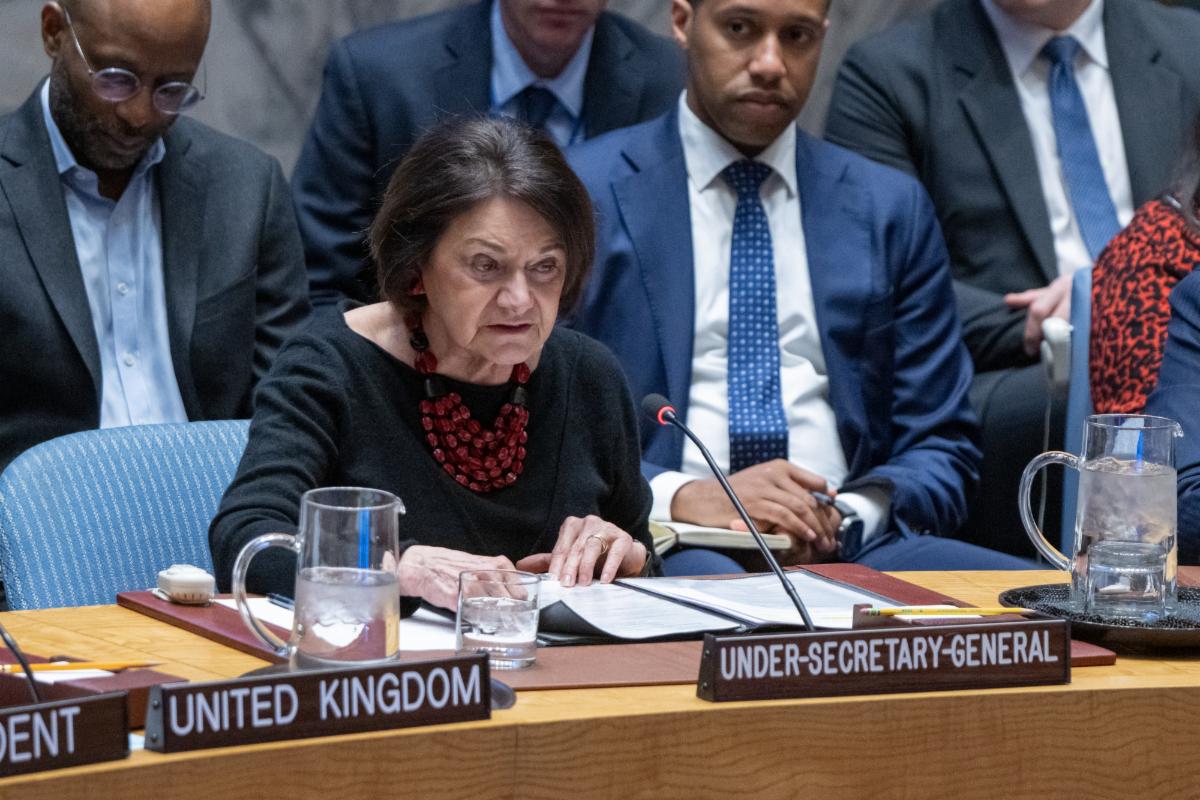
Under-Secretary-General Rosemary A. DiCarlo's
Remarks to the Security Council on Children, Technology, Education and Conflict
New York, 2 March 2026
Madam President,
On behalf of the Secretary-General, I want to thank you for your leadership in organizing today’s discussion.
This debate comes at a moment of exceptional relevance. Today, we face the highest number of armed conflicts since the Second World War. The number of civilians killed in these conflicts is the highest in decades.
Our reality is clear: when conflicts erupt, children are among those most severely affected
We have been reminded of this truth over the last two days. Schools in Israel, the United Arab Emirates, Qatar, Bahrain and Oman have closed and moved to remote learning owing to the ongoing military operations in the region.
And we are aware of the reports from Iran about the death of possibly dozens of children allegedly as the result of a strike that hit an elementary school in the town of Minab. United States authorities have announced that they are looking into these reports.
Globally, one in every five children is living in or fleeing a conflict zone. This adds up to 473 million children.
Grave violations against children verified by the United Nations increased by a staggering 25 per cent from 2023 to 2024. Rape and other forms of sexual violence rose by 35 per cent.
These horrific figures should impel us to do more to protect children in conflict.
I pay tribute to the First Lady of the United States for her work to give visibility to the issue of children in conflict, and particularly for her personal engagement to reunite Ukrainian children with their families.
Madam President,
When conflicts do not rob children of their life and physical security, they deprive them of their right to have a quality education and a future of opportunities.
234 million children in crisis and conflict situations currently need educational support. 85 million are completely out of school.
In violent conflicts, schools can be one of the only safe spaces that protect children from recruitment, trafficking, and exploitation. Schools can safeguard health and hygiene, provide psychosocial support, and connect families to essential services.
Education in conflict zones is lifesaving and life-sustaining.
And yet, schools, teachers and education infrastructure continue to suffer violence. In 2024 alone, the United Nations verified a total of 2,374 attacks on schools and hospitals. Many more are unverified, due to lack of access.
Most attacks in 2024 took place in Ukraine, Israel, the occupied Palestinian territory and Haiti.
In its resolution 2601 (2021), the Council urged all conflict parties to immediately cease attacks against schools, children and teachers, and noted that such attacks are in contravention of international humanitarian law.
It called on all parties to safeguard, protect, respect, and promote the right to education.
The international legal framework is clear. We must act.
Madam President,
The challenges of providing quality education in conflict situations are tremendous.
Infrastructure, from electricity to classrooms to digital connectivity, is often crumbling, or at risk.
Educators are few and far between; we face a shortage of 44 million teachers in conflict settings.
Digital learning can offer access to education when schools are closed or inaccessible, or when students are fleeing violence. The UN has made a concerted investment in these approaches.
Public-private partnerships, when grounded in strong ethical frameworks, can help us deliver and expand access to innovative education technologies.
For example, UNICEF’s Learning Passport – developed in partnership with Microsoft – offers 10 million children in 47 countries a mobile learning platform where they can have continuous access to quality education.
The Instant Network Schools programme, a joint project of the Vodafone Foundation and UNHCR, allows refugees and teachers to access digital educational content and the internet, improving the quality of education in some of the most marginalised communities in the Democratic Republic of the Congo and South Sudan.
Technology allows education to reach the most vulnerable, and those excluded from the formal educational system.
In Afghanistan, to respond to the exclusion of 2.2 million girls from education, UNESCO is mobilizing digital technologies to bring learning directly into homes and communities – reaching close to 9,000 school communities in the country.
To ensure that the opportunities provided by technology are realized, we must mitigate its risks. Children in conflict face heightened online threats: exploitation, trafficking, radicalization, digital recruitment into armed groups, and cyberbullying.
Digital education must therefore actively promote child protection, with risk assessments at every stage, from conception to deployment.
We must strengthen legal and policy frameworks to protect the rights of the child in the digital space, in line with international human rights law.
Technology companies have a particular role to play in providing safeguards to their users, especially children and young people.
Unfortunately, funding for education in emergencies has dropped by 24 per cent, even though needs are increasing.
We call on Member States to do more to meet funding gaps in education.
Madam President,
The most effective way to protect children from conflict is to prevent and end wars.
Building peace is at the heart of what the United Nations does.
We must all work together toward this goal.
Thank you, Madam President.