|
|
|

|
|
|
|
|
|
|
|
|
|
|
|
|
|
|
|
|
|
|
|
|
|
|
|
|
|
|
|
|
|
|
|
|
|
|
|
|
|
|
|
|
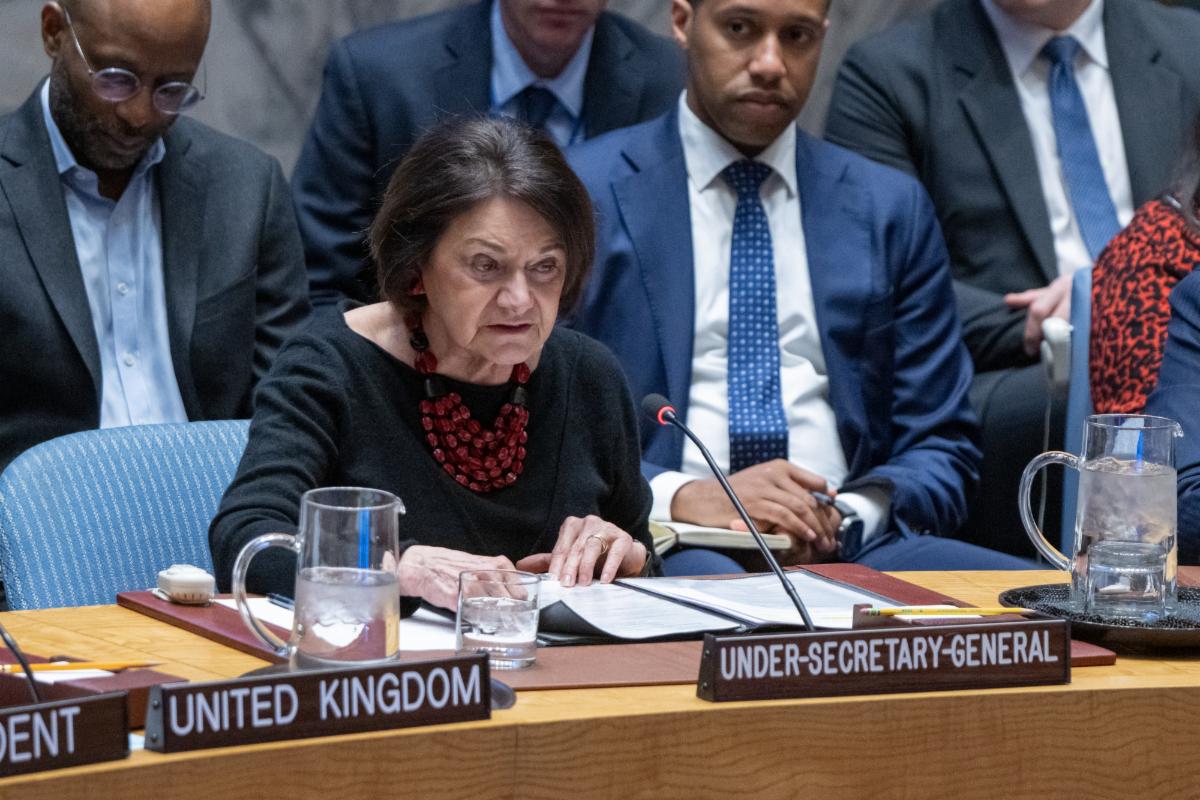
Thank you, Madam President,
Just over a month ago, Sudan reached a horrific milestone: 1,000 days of a brutal war that has nearly destroyed the third largest country in Africa.
1,000 days of staggering violence and unimaginable suffering.
1,000 days of total impunity for the perpetrators of a long list of atrocities and war crimes.
And as we near the fourth year of the war, the fighting continues to expand. In recent weeks, the frontlines have fluctuated in North Darfur, North Kordofan, South Kordofan and Blue Nile states.
In South Kordofan state, the Sudanese Armed Forces (SAF) reported breaking sieges by the Rapid Support Forces (RSF) on Kadugli and Dilling.
The security situation in these areas remains fluid, with military activity – including drone attacks – putting civilians at great risk.
North Kordofan remains a focus of conflict. The state’s capital, El Obeid, is besieged from three sides by the RSF.
The SAF continue to reintroduce their presence in and around the city – a key logistical hub for ongoing operations in the Kordofan region.
Ground fighting inside El Obeid would have catastrophic consequences and deal a significant blow to the prospects for a ceasefire.
The RSF have also opened a new front in Blue Nile state, where they launched attacks on southern localities in January.
While the RSF seem to be in control of most of Darfur, fighting has recently erupted in North and West Darfur between the RSF and the SAF and their Joint Forces allies, including clashes along the Sudan-Chad border.
Across these battlegrounds and beyond, the use of long-range drones and aerial strikes by both parties has become a defining feature of this conflict.
The consequences for civilians and civilian infrastructure are severe. No corner of Sudan is safe from the threat of attack.
Madam President,
The risk of regionalization of the conflict is a matter of urgent concern.
On 16 January, the Government of Chad announced that seven Chadian soldiers had been killed during a confrontation with RSF elements in the border area.
The RSF later acknowledged the clash, characterizing the incident as an “unintentional mistake”.
Movements of armed groups across Sudan and South Sudan’s border in both directions continue to be reported.
These are only some of the potential flashpoints in the Sudanese war that could destabilize the broader region.
Reports indicate that weapons also continue to transit through Sudan’s neighbors.
Escalating tensions and rhetoric among neighboring states over the situation in Sudan underscore the impact of the conflict on regional stability.
Madam President,
The horrific events in El Fasher in October 2025 were preventable.
While El Fasher was under siege for more than a year, the Office of the High Commissioner for Human Rights repeatedly sounded the alarm about the risk of mass atrocities.
But the warnings were not heeded.
High Commissioner Türk has now alerted the global community to the possibility of similar crimes in Kordofan.
Civilians are again at risk of summary executions, sexual violence, arbitrary detention and family separation.
During the final offensive of the RSF on El Fasher, reports indicate that sexual violence against women and girls was widespread. Women and girls are also particularly vulnerable to displacement, poverty and systemic exclusion.
The time to act to prevent a repeat of atrocities elsewhere in the country is now.
The parties to the conflict must adhere to international humanitarian law and human rights law.
Those who violate these laws must be held accountable.
Madam President,
Amid this bleak picture, efforts to find a path toward peace are intensifying.
We welcome the progress in the initiative led by the Quad countries – Egypt, the Kingdom of Saudi Arabia, the United Arab Emirates and the United States – to secure a humanitarian truce in Sudan.
These efforts offer a critical opportunity for immediate and much-needed de-escalation and could pave the way for a sustainable cessation of hostilities.
We call on both parties to the conflict to engage with this initiative in good faith and without preconditions.
We welcome ongoing discussions on potential United Nations support to the implementation of a humanitarian truce.
Madam President,
Alongside work to silence the guns, progress on charting a political vision for the future of Sudan is of utmost urgency.
We must anchor any ceasefire in a credible political process that can pave the way for an inclusive transition.
And we are firmly committed to ensuring that voices reflecting Sudan’s diversity are heard.
The partnership among the Quintet members – combining the capacities of the African Union, the European Union, the Intergovernmental Authority on Development, the League of Arab States and the United Nations – is central to this work.
We will continue working to ensure that mediation initiatives are well coordinated and based on our respective comparative advantages and a clear delineation of labour.
Madam President,
It is critical for all of Sudan’s partners to be united behind peace efforts.
This entails ensuring that the flow of weapons to the warring parties is cut off. The war has gone on this long and been this deadly in large part because of the support the parties have received from abroad.
Unified messaging and strong action by the Security Council is more important than ever.
Pressure must be brought on the parties and those who back them to end the war now.
The parties must also know that there will be accountability.
For our part, we will continue to do everything within our means to help bring this devastating conflict to an end.
Thank you, Madam President.
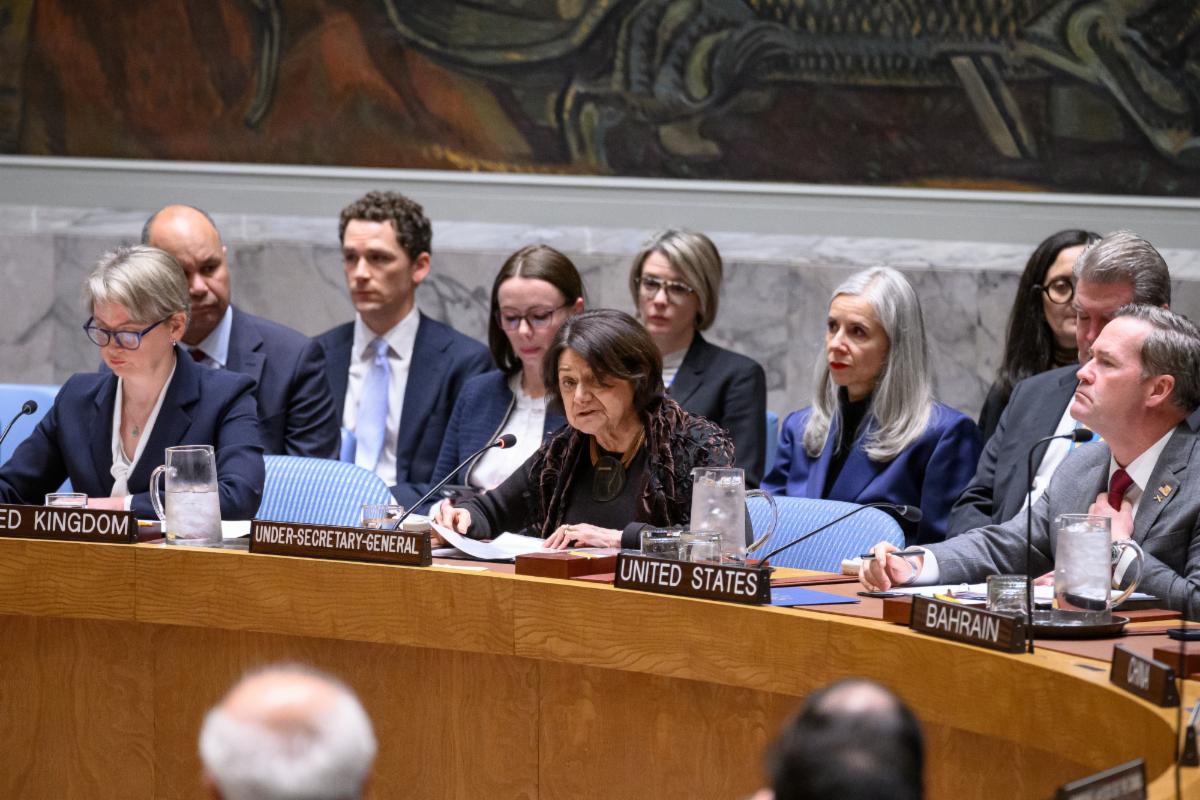
Thank you, Madam President.
This is a pivotal moment in the Middle East.
After years of devastating conflict and immense human suffering, there is an opening, one that could allow the region to move in a different direction. But that opening is neither assured nor indefinite.
The decisions taken in the coming weeks – by the parties and by members of this Council – will determine whether it is sustained.
Our collective efforts must now consolidate the ceasefire in Gaza and alleviate the suffering of the population.
We need concrete progress toward stabilization and recovery, consistent with international law, to lay the foundations for lasting peace.
The Board of Peace meeting in Washington, D.C., tomorrow is an important step.
We have a responsibility to work collectively to implement Phase II of the Gaza ceasefire and advance efforts toward a credible political path leading to a negotiated two-State solution.
This must include the demilitarization of the Strip, the decommissioning of weapons held by Hamas and other Palestinian armed groups, and the establishment of security arrangements that can facilitate the important transitional governance tasks of the National Committee for the Administration of Gaza.
In parallel, the entry of assistance into Gaza must increase significantly. This is essential for an inclusive, Palestinian-led recovery and reconstruction.
Madam President,
Encouraging progress has been made since the ceasefire came into effect last October in aid access and delivery.
Still, the vast majority of Gaza’s population remains displaced and continues to endure extremely harsh living conditions.
Humanitarian operations in Gaza have continued amid severe constraints. Scaled-up entry of shelter materials, educational supplies, and medical equipment, among other items, is urgently required.
The UN and its partners are expanding efforts to stabilize and rehabilitate essential systems and services as a bridge for longer-term recovery.
The opening of the Rafah crossing to pedestrian movement in both directions on 2 February was a welcome development.
The UN team on the ground is working closely with local and international stakeholders to promote a safe, dignified environment at the crossing and enable those in need to access medical assistance.
The UN supported the medical evacuation of many patients and received hundreds of returnees. Thousands still urgently require treatment unavailable in Gaza.
We remain committed to supporting the implementation of Security Council resolution 2803 and all relevant resolutions.
Madam President,
Despite the ceasefire, Gaza is still not at peace.
In recent weeks, the Israeli military intensified strikes across Gaza, hitting densely populated areas and killing dozens of Palestinians.
Air strikes were particularly heavy on 31 January and in early February.
Armed exchanges between Palestinian armed groups and Israeli soldiers have also continued.
In the occupied West Bank, meanwhile, the situation is deteriorating rapidly.
There, Israeli forces continued large-scale operations across the West Bank, frequently involving live fire and raising serious concerns about the use of lethal force.
Widespread raids have been accompanied by home takeovers, mass detentions, movement restrictions, and repeated displacement of Palestinian families, particularly in the north.
Attacks by Palestinians against Israelis, and confrontations between Palestinians and Israeli security forces, have also continued.
Israeli authorities also expanded operations in areas around Jerusalem and extended their operations in the northern West Bank.
These developments unfolded alongside continued settlement expansion, rising settler violence, and accelerated demolitions and evictions in East Jerusalem.
We are witnessing the gradual de facto annexation of the West Bank, as unilateral Israeli steps steadily transform the landscape.
I echo the Secretary-General’s grave concern regarding the Israeli security cabinet’s reported decision to authorize a series of enforcement measures and transfer of authorities in Areas A and B of the occupied West Bank.
If implemented, these measures will constitute a dangerous expansion of Israeli civil authority in the occupied West Bank, including in sensitive areas like Hebron.
The moves could lead to settlement expansion by removing bureaucratic barriers and easing land purchases and building permits.
I reiterate the Secretary-General's condemnation of the Israeli government’s 15 February decision to resume land registration procedures in Area C of the occupied West Bank.
The decision threatens to dispossess Palestinians of their property and expand Israeli control over land in the area.
Israel should immediately reverse these measures.
All Israeli settlements in the occupied West Bank, including East Jerusalem, and their associated regime and infrastructure, have no legal validity. They violate international law and UN resolutions.
Madam President,
Continued unilateral Israeli measures to withhold clearance revenues have deepened a persistent fiscal crisis for the Palestinian Authority.
This has led to partial salary payments for civil servants, severe cuts to basic services, and growing arrears and debt to the private sector and financial institutions.
Correspondent banking agreements, essential for the Palestinian economy, were renewed on 12 February for an additional two weeks.
A long-term extension, alongside renewed technical discussions between Israeli and Palestinian financial regulators, is critical for financial stability and for enabling large-scale recovery in Gaza, in line with Resolution 2803.
Madam President,
Allow me to conclude by stressing that at this fragile juncture for the region, we cannot afford half measures.
The US-led Comprehensive Plan must be implemented fully, alongside urgent action to de-escalate and reverse the dangerous trajectory in the occupied West Bank.
At the same time, we must seize this opportunity to restore a credible political horizon - one that leads to a lasting peace in Gaza, brings an end to the occupation and realizes a two-State solution in line with international law and relevant United Nations resolutions.
The United Nations remains steadfast in our commitment to that goal and to supporting Palestinians and Israelis in achieving it.
Thank you.
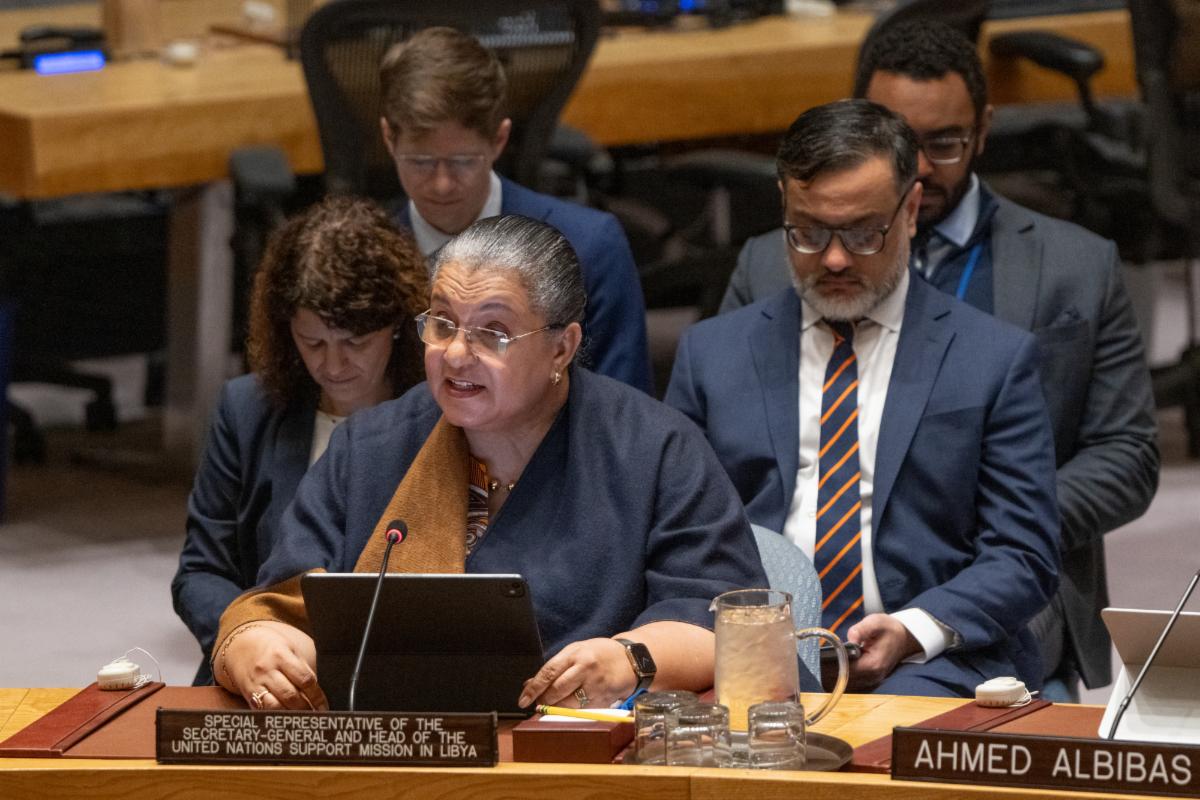
Libya’s prolonged political stalemate, worsening economic conditions and an emerging split within the judiciary pose mounting risks to the country’s unity, the UN’s top envoy for the country, Hanna Serwaa Tetteh, told the Security Council on Wednesday.
At least 52 people have died after Tropical Cyclone Gezani made landfall on the eastern coast of Madagascar on 10 February, the UN Office for the Coordination of Humanitarian Affairs (OCHA) said on Tuesday, citing the authorities.
Palestinian Walid Al-Assi was playing with his young granddaughter this week, promising to take her to the market in Gaza City with the arrival of the holy month of Ramadan as his family had done before the Israel-Hamas war, but now circumstances had changed.
As the war in Sudan approaches a fourth year, the UN refugee agency, UNHCR, and 123 partners appealed on Tuesday for $1.6 billion to support millions of people forced to flee the country in pursuit of safety.
UN Secretary-General António Guterres has condemned Israel’s decision to resume land registration procedures in a large part of the occupied West Bank, his Spokesman said on Monday.
The Tawila camp for internally displaced in Sudan’s war-torn Darfur region is home to more than half a million people who live in makeshift huts of sticks, hay and plastic sheeting.
More than 60 years after the UN launched its formal decolonization drive, Secretary-General António Guterres on Monday urged renewed commitment to completing the unfinished business of ending colonial rule.
Calling for sweeping reforms of global institutions, UN Secretary-General António Guterres told African leaders on Saturday that the absence of permanent African seats on the Security Council is “indefensible,” declaring: “This is 2026 – not 1946.”
|
|
|
|
|
|
|
|
|
|
|
|
|
|
|
|
|
|
|
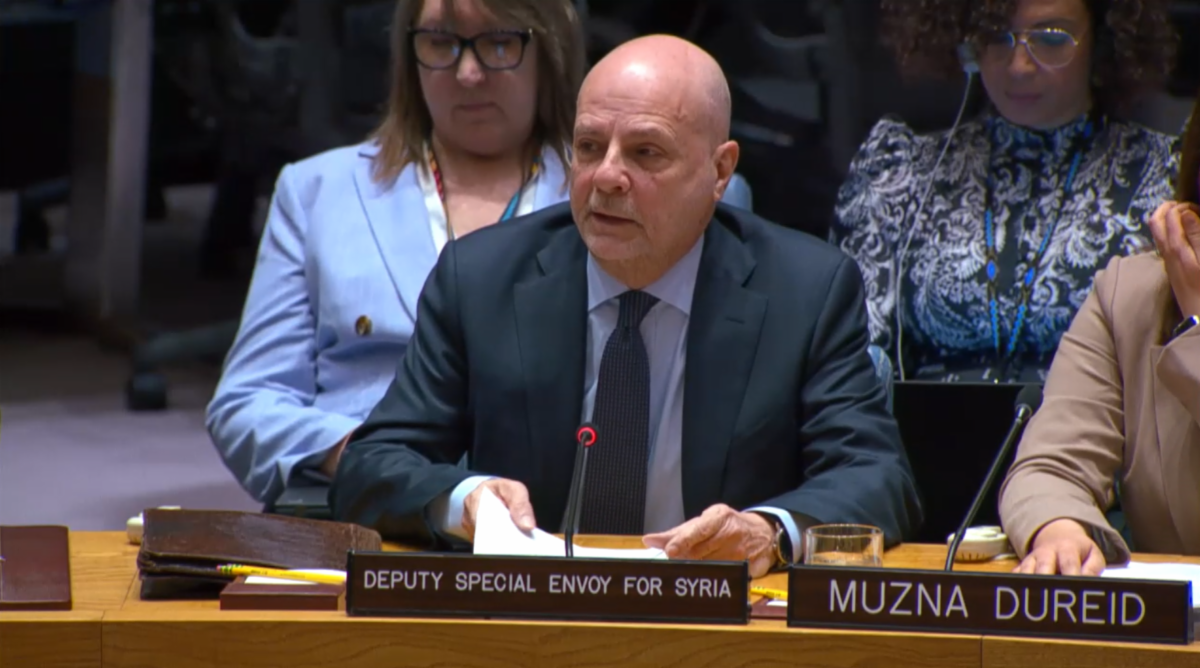
Syria’s fragile political transition has gained fresh momentum with a landmark agreement between Damascus and Kurdish authorities in the northeast, but renewed violence in the south, Israeli incursions and deep humanitarian needs underscore how precarious the path to stability remains, senior UN officials told the Security Council on Friday.
A sharp increase in drone attacks across the Kordofan region in the centre of Sudan is endangering civilians and damaging critical infrastructure.

Indigenous Peoples — around 476 million across 90 countries — are among the planet’s fiercest biodiversity guardians. And many live on the frontlines of conflict: 80 percent of armed conflicts globally are unfolding in biodiversity-rich hotspots. Indigenous women in particular bear the brunt of these overlapping crises, even as they lead the way in advancing climate and peace initiatives.
Against this backdrop, DPPA, UN Women, the United Nations Women’s Peace and Humanitarian Fund (WPHF) and the United Nations Environment Programme (UNEP) — supported by the Global Alliance of Indigenous Peoples, Gender Justice and Peace — brought together Indigenous women leaders on 19 November 2025, at the COP30 joint Pavilion of IOM and the Brazilian Ministry of Environment and Climate Change. The session spotlighted the powerful nexus between Indigenous women’s leadership, climate action and peace, aligning with COP30 Goals 6 and 19 and SDGs 5, 13 and 16.
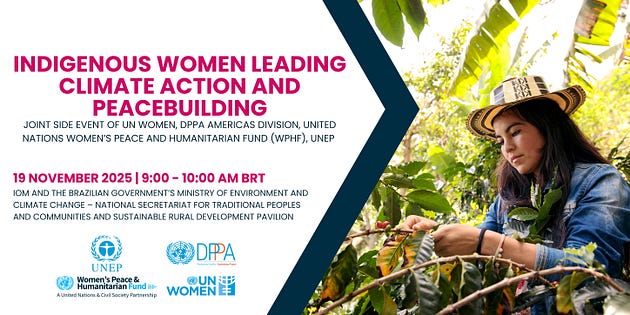
Binalakshmi Nepram, Indigenous peacebuilder from Manipur, India, and moderator of the event, opened the discussion with a clear message: Indigenous women remain excluded from global climate and peace decision-making, even though they are essential to solutions. She highlighted the role of the Global Network of Indigenous Peacebuilders in amplifying their voices.
Speakers from four continents shared powerful testimonies.
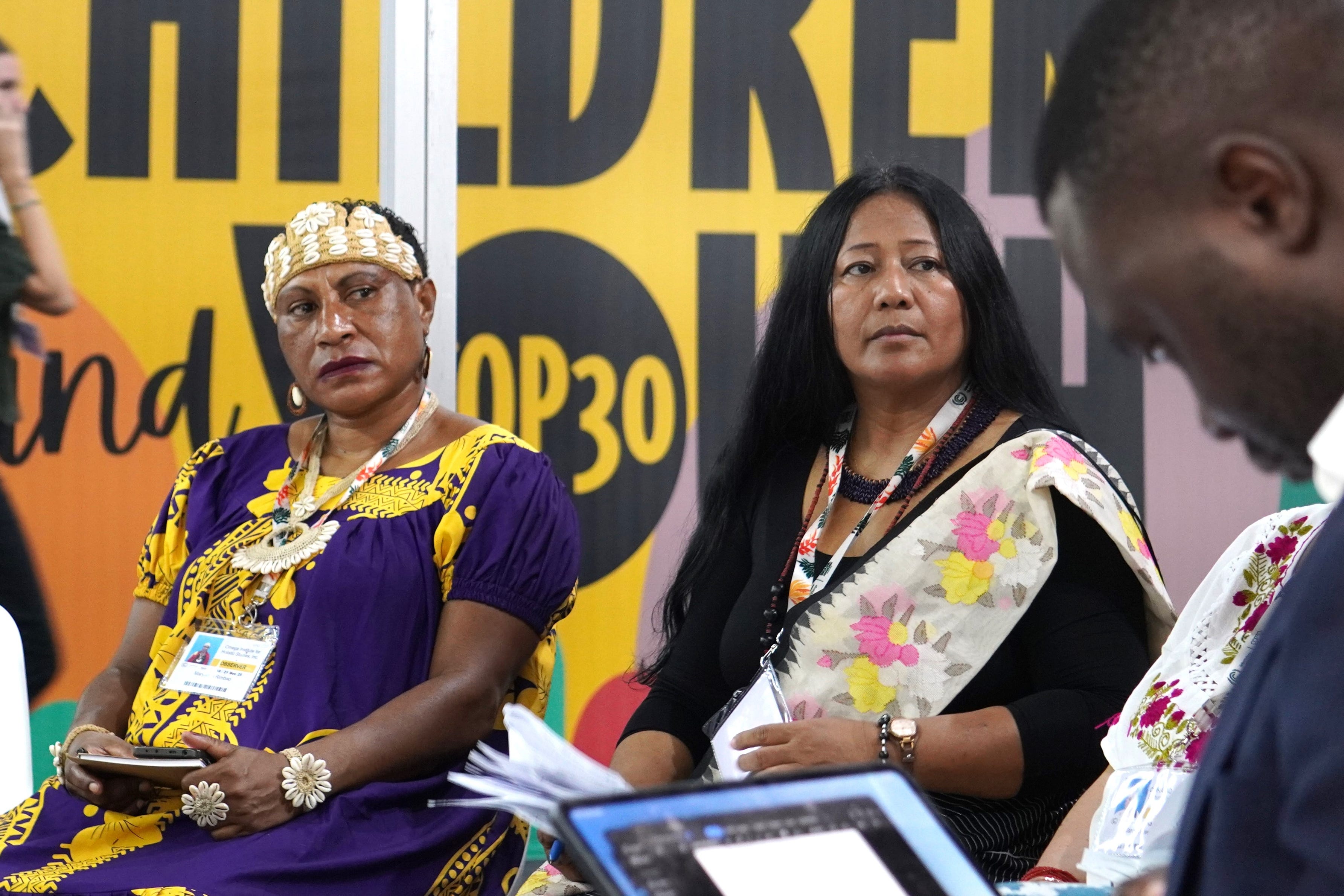


Maryanne Rimbao, founder and director of Humanity and Nature Indigenous Women’s Association of Papua New Guinea (PNG), described how her country is experiencing rising sea levels, landslides and climate-induced displacement. She highlighted how Indigenous women mediate conflicts and protect communities despite cultural stigma and ongoing risks.
Tarcila Zea Rivera, an Indigenous woman from Peru and director of the Center for Indigenous Cultures of Peru, CHIRAPAQ, explained how extreme heat and other climate impacts threaten food security in forest and Andean communities, stressing that peace requires understanding ecosystems, embracing intercultural knowledge and respecting Indigenous knowledge.
Nohora Alejandra Quiguantar, Indigenous youth leader and environmental human rights defender from Colombia, illustrated how Indigenous women are leading land recovery, forest restoration and community revitalization in areas affected by conflict and climate change. She added, though, that programs focusing on climate and women, peace and security remain insufficient.
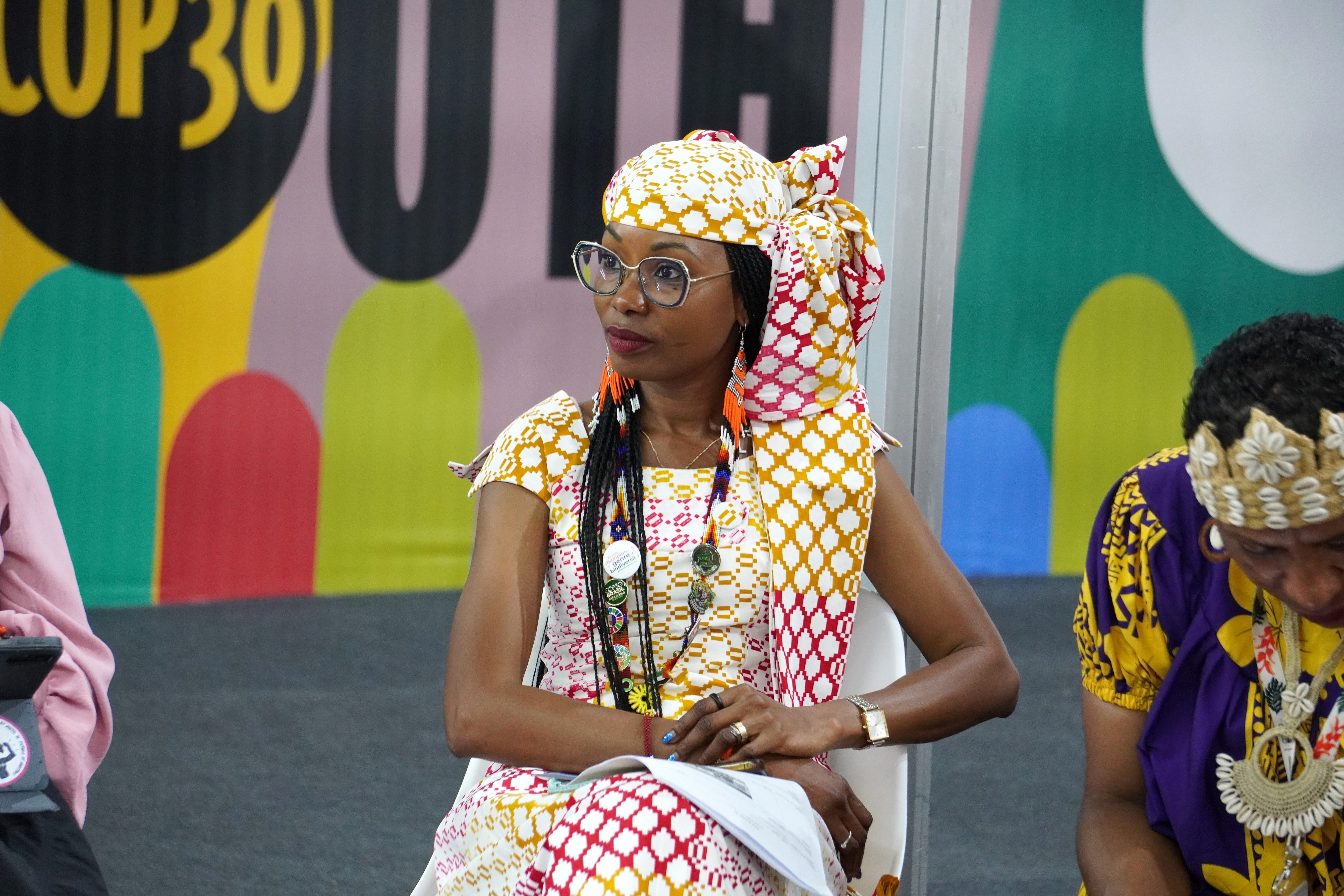
Hindou Oumarou Ibrahim, Member of the UN Permanent Forum on Indigenous issues and founder of the Association for Indigenous Women and Peoples of Chad, described how droughts, floods and desertification in the Sahel drive conflict and insecurity, with Indigenous women disproportionately affected and lacking access to resources.
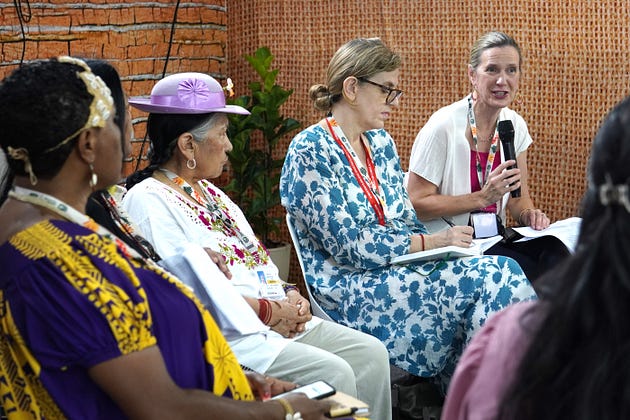
Across all interventions, a common theme emerged: only a fraction of bilateral aid in conflict settings targets gender equality, and funding for initiatives that link climate action with Women, Peace and Security is exceedingly rare. This gap severely limits the scale and impact of Indigenous women’s grassroots initiatives.
From the UN System, Sarah Hendriks, Director of the Policy, Programme and Intergovernmental Division at UN Women, emphasized that while Indigenous women are leading innovative environmental protection and conflict-prevention efforts, they face severe risks. She urged the global community to commit predictable, flexible, and accessible financing and protect Indigenous women’s rights and leadership. Tendai Kasinganeti, Climate, Peace and Security Advisor with the UN Office to the African Union (UNOAU), underscored ongoing UN efforts to integrate climate related risks into peace and prevention work, with a focus on conflict-sensitive, inclusive approaches that empower Indigenous women.
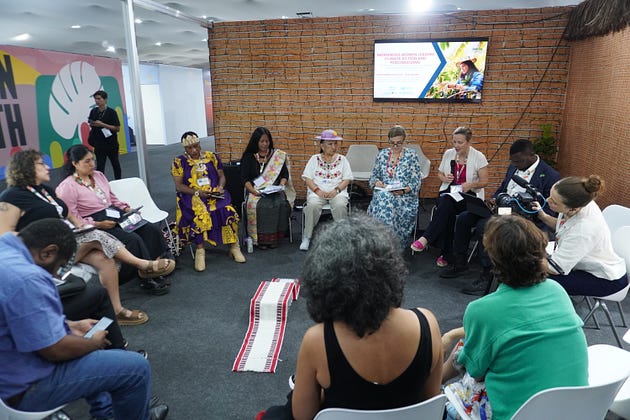
Meanwhile, Ambassador Mateja Vodeb Ghosh, Head of Sector for Global Challenges at the Ministry of Foreign and European Affairs of Slovenia, highlighted how her country linked women, peace and security with climate issues during its Security Council term (2024–2025) and the vital leadership of Indigenous women in these interconnected areas.
The session concluded with a united call: to recognize and support Indigenous women’s leadership in climate action, peacebuilding and environmental protection by reflecting their knowledge in global frameworks; to ensure their meaningful participation in climate and peace decision-making; to strengthen Indigenous-led platforms such as the 2026 Second Global Summit on Indigenous Peacebuilding; and to increase funding for gender-responsive, Indigenous-led climate and peace initiatives.
Amid reported heavy Russian strikes across Ukraine on Thursday, UN human rights chief Volker Türk has condemned the “continual bombardment” the country’s people are facing.
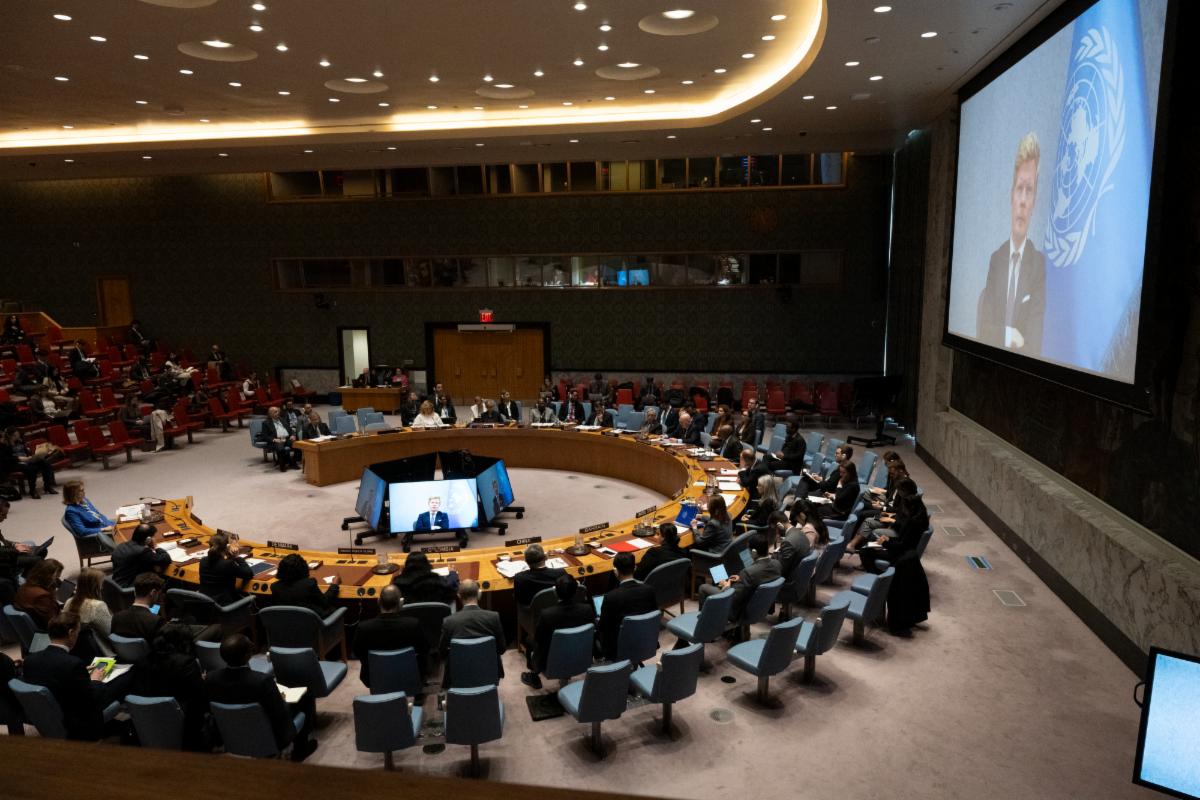
The UN Special Envoy for Yemen on Thursday welcomed recent steps to bolster stability and improve living conditions, but told the Security Council that only a renewed political process can end the country’s long-running conflict.
After three decades of its mandate to protect children caught up in war, the UN’s top advocate on the issue is determined to remind the world that prevention and protection go hand in hand.
Escalating aerial attacks in Sudan are killing children, damaging schools and striking United Nations facilities, placing civilians and humanitarian workers at growing risk, the UN warned on Wednesday.
Broadcaster Rami Al-Sharafi works on a laptop inside the damaged Zaman FM radio station building in Gaza, marking what may seem an unlikely return to the airwaves amid the rubble of the deadly two-year Israel-Hamas war.
The UN Secretary-General has expressed his sorrow over Tuesday’s deadly shooting at a school in rural Canada that left at least eight dead and 25 wounded.
A UN humanitarian convoy reached frontline communities in Ukraine’s Dnipro region on Wednesday, delivering critical medical and hygiene supplies as fighting continues to take a heavy toll on civilians and infrastructure across the country.
Relentless violence, famine and disease are fuelling a rising death toll among children in Sudan, while attacks on healthcare and a lack of aid access hamper efforts to help them, UN aid agencies warned on Tuesday.
Fresh airstrikes and shelling across the Gaza Strip over the past 24 hours have put civilians at renewed risk and compounded months of hardship, the UN said on Tuesday, warning that humanitarian needs continue to outpace access and capacity.
UN human rights chief Volker Türk appealed on Tuesday to all parties involved in renewed heavy fighting in Ethiopia’s ‘precarious’ Tigray region to step back, warning of the potential for a deepening crisis in the country’s war-weary north and beyond.
Escalating violence, political stalemate and humanitarian constraints are pushing South Sudan’s civilians to the brink once again, while funding cuts weaken the UN mission tasked with protecting them.
DPPA is requesting $1.7 million in earmarked contributions for its work on Sudan to respond to escalating crisis demands, strengthen political analysis and reporting, and support sustained good offices and mediation efforts. A fully funded Multi-Year Appeal (MYA) will also enable follow-up to the Pact for the Future, which calls on the Secretary-General to actively leverage his good offices and ensure the United Nations is adequately equipped to lead and support mediation, good offices, and peacemaking in this rapidly evolving context.
DPPA is requesting $800,000 in earmarked contributions for its work on Ukraine to sustain political engagement, fact-finding, and analysis, and to support the United Nations’ good offices amid an evolving and highly complex conflict. A fully funded Multi-Year Appeal (MYA) will ensure the UN remains equipped to provide timely political support, informed reporting, and sustained engagement to advance prospects for peace in line with the UN Charter and relevant resolutions.
DPPA is requesting $3 million in earmarked contributions for our work on the Middle East to sustain mediation, political analysis, and strategic engagement amid multiple interlocking crises. A fully funded Multi-Year Appeal (MYA) will also enable follow-up to the Pact for the Future, which calls on the Secretary-General to actively leverage his good offices and ensure the United Nations is adequately equipped to lead and support mediation, good offices, and peacemaking in this rapidly evolving context.
South Africa has moved to withdraw its peacekeepers deployed at the United Nations Organization Stabilization Mission in the Democratic Republic of the Congo (MONUSCO) after nearly three decades of service.
As the brutal Sudan war shows no signs of ending, UN human rights chief Volker Türk on Monday called on the international community to intervene immediately to stop more mass killings and other flagrant war crimes against civilians.
UN Secretary-General António Guterres voiced grave concern on Monday over the reported decision by the Israeli security cabinet to authorize a series of administrative and enforcement measures in Areas A and B in the occupied West Bank.
The UN Secretary-General has strongly condemned the surge in violence across South Sudan, warning that civilians and aid workers are paying a devastating price as humanitarian operations are increasingly targeted.
|
|
|
|
|
|
|
|
|
|
|
|
|
|
|
|
|
|
|
|
Attacks on Ukraine’s power system highlight how the ongoing war threatens the safety of the country’s nuclear facilities, the head of the International Atomic Energy Agency (IAEA) warned on Friday.
UN Secretary-General António Guterres on Friday welcomed the resumption of talks between Iran and the United States.
The UN reiterated concerns on Friday over reports that Israeli forces sprayed a highly toxic herbicide over areas north of the Blue Line separating Lebanon from Israel on 1 February.
The global system governing nuclear disarmament is facing its most serious crisis in decades, driven by growing mistrust among major powers and the steady erosion of arms control agreements, a senior disarmament expert has warned.
The UN Secretary-General on Friday strongly condemned an attack on worshippers at a mosque in Pakistan’s capital, Islamabad, after an explosion during prayers reportedly killed dozens and injured many more.
The United Nations has welcomed signs of progress in talks aimed at reducing violence in eastern Democratic Republic of the Congo.
The UN on Wednesday warned of potential humanitarian “collapse” in Cuba, following Washington’s attempt to block oil supplies from reaching the island.
The head of UN Peacekeeping on Thursday called for greater support for international police officers deployed to field missions at a time when financial resources are dwindling and multilateralism is waning.
Acute malnutrition among children has reached catastrophic levels in parts of Sudan’s North Darfur and Greater Kordofan, UN-backed analysts warned on Thursday, as conflict, mass displacement and denials of aid push the country deeper into a famine-risk emergency.
The UN Secretary-General on Thursday strongly condemned a deadly terrorist attack in Kwara state in western Nigeria, where more than 100 people were reportedly killed.
As World Cancer Day is marked on Wednesday, thousands of patients in Gaza face worsening illness, untreated pain and closed crossings – despite the limited opening of the vital route through Rafah this week.
UN Secretary-General António Guterres has warned that the expiration of the New START treaty represents a “grave moment” for international peace and security, as binding limits on US and Russian strategic nuclear weapons fall away amid heightened global tensions.
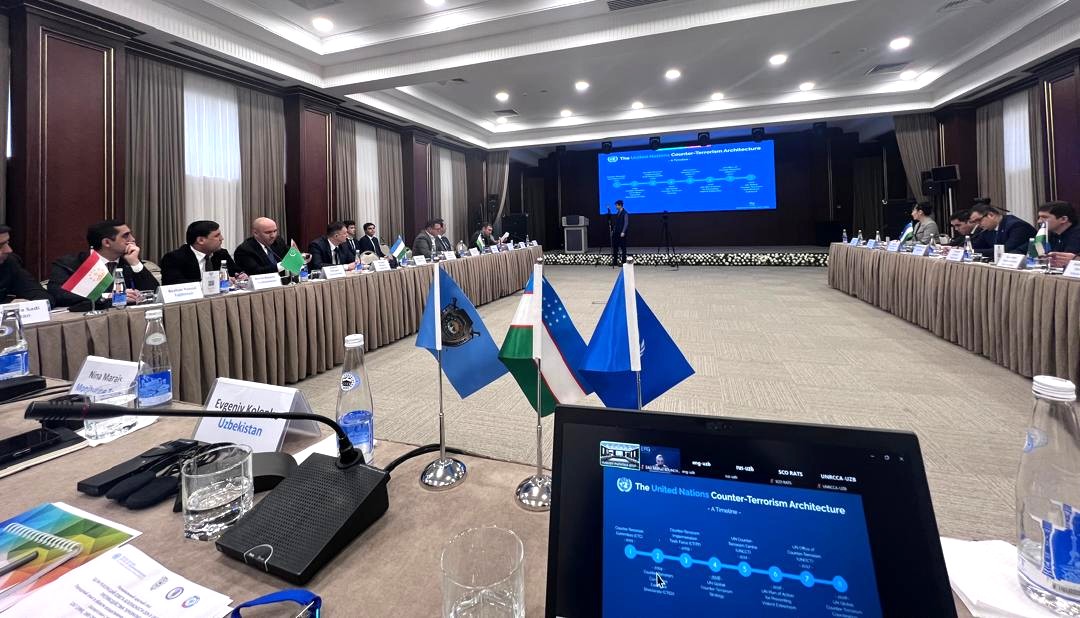
The terrorist group ISIL continues to adapt and demonstrate resilience despite sustained counter-terrorism efforts, a senior UN official told the Security Council on Wednesday.
South Sudan is buckling under a fresh wave of violence and displacement, after attacks and looting halted a major UN food convoy in restive Upper Nile state and clashes continue to spread in neighbouring Jonglei.
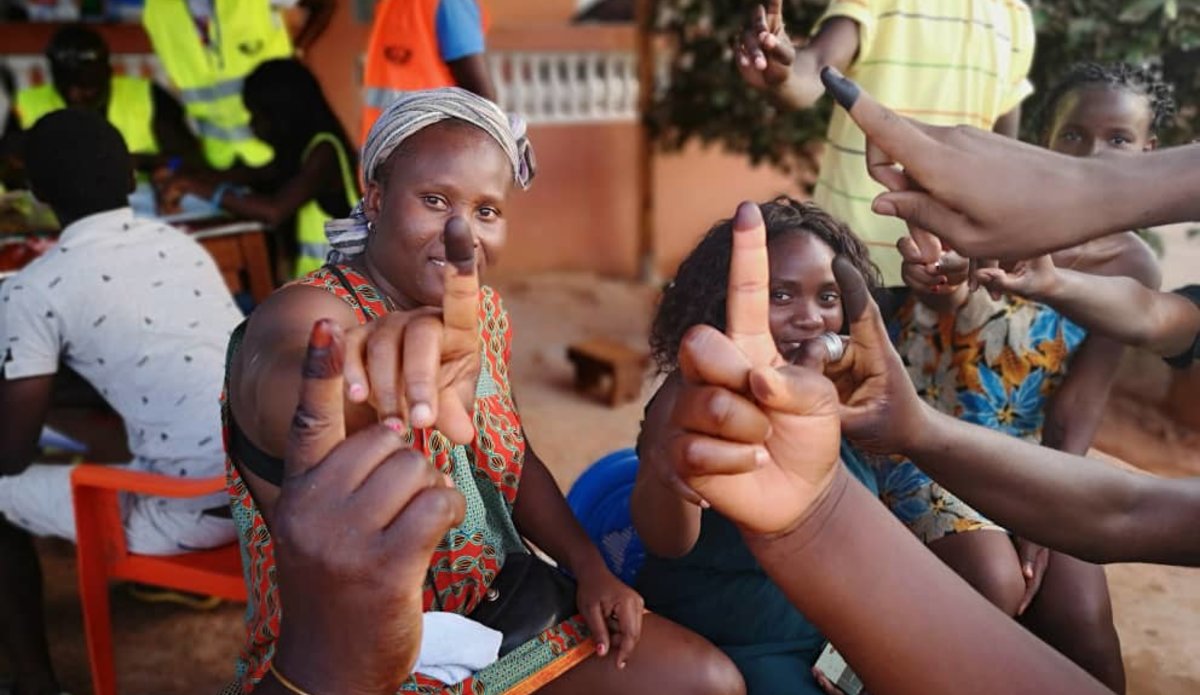
UN electoral assistance is adapting to a rapidly changing global context marked by shrinking civic space, digital transformation and persistent barriers to inclusive participation, particularly for women. Coordinated by DPPA through its Electoral Assistance Division, UN electoral support helps Member States deliver impartial, credible elections that promote peace and prevent conflict, supported in part through the Multi-Year Appeal.
The UN committee mandated to promote Palestinian rights opened its 2026 session on Tuesday with renewed calls for a two-State solution, amid a shaky ceasefire in Gaza and continued settler expansion in the West Bank.