Under-Secretary-General Rosemary A. DiCarlo's
Remarks to the Security Council on Sudan
New York, 19 February 2026
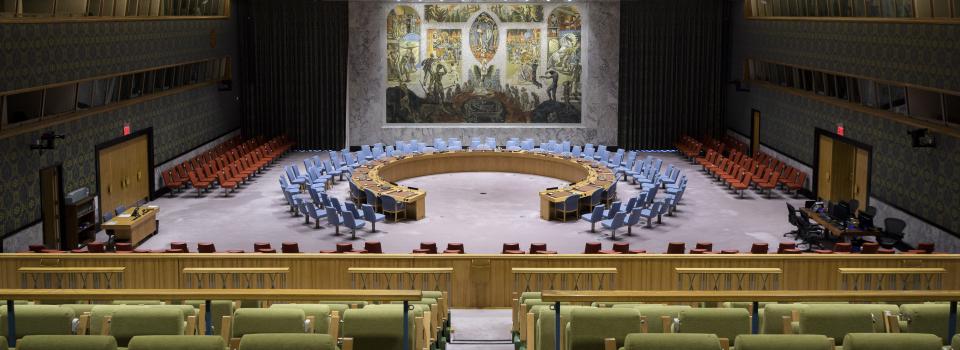
Thank you, Madam President,
Just over a month ago, Sudan reached a horrific milestone: 1,000 days of a brutal war that has nearly destroyed the third largest country in Africa.
1,000 days of staggering violence and unimaginable suffering.
1,000 days of total impunity for the perpetrators of a long list of atrocities and war crimes.
And as we near the fourth year of the war, the fighting continues to expand. In recent weeks, the frontlines have fluctuated in North Darfur, North Kordofan, South Kordofan and Blue Nile states.
In South Kordofan state, the Sudanese Armed Forces (SAF) reported breaking sieges by the Rapid Support Forces (RSF) on Kadugli and Dilling.
The security situation in these areas remains fluid, with military activity – including drone attacks – putting civilians at great risk.
North Kordofan remains a focus of conflict. The state’s capital, El Obeid, is besieged from three sides by the RSF.
The SAF continue to reintroduce their presence in and around the city – a key logistical hub for ongoing operations in the Kordofan region.
Ground fighting inside El Obeid would have catastrophic consequences and deal a significant blow to the prospects for a ceasefire.
The RSF have also opened a new front in Blue Nile state, where they launched attacks on southern localities in January.
While the RSF seem to be in control of most of Darfur, fighting has recently erupted in North and West Darfur between the RSF and the SAF and their Joint Forces allies, including clashes along the Sudan-Chad border.
Across these battlegrounds and beyond, the use of long-range drones and aerial strikes by both parties has become a defining feature of this conflict.
The consequences for civilians and civilian infrastructure are severe. No corner of Sudan is safe from the threat of attack.
Madam President,
The risk of regionalization of the conflict is a matter of urgent concern.
On 16 January, the Government of Chad announced that seven Chadian soldiers had been killed during a confrontation with RSF elements in the border area.
The RSF later acknowledged the clash, characterizing the incident as an “unintentional mistake”.
Movements of armed groups across Sudan and South Sudan’s border in both directions continue to be reported.
These are only some of the potential flashpoints in the Sudanese war that could destabilize the broader region.
Reports indicate that weapons also continue to transit through Sudan’s neighbors.
Escalating tensions and rhetoric among neighboring states over the situation in Sudan underscore the impact of the conflict on regional stability.
Madam President,
The horrific events in El Fasher in October 2025 were preventable.
While El Fasher was under siege for more than a year, the Office of the High Commissioner for Human Rights repeatedly sounded the alarm about the risk of mass atrocities.
But the warnings were not heeded.
High Commissioner Türk has now alerted the global community to the possibility of similar crimes in Kordofan.
Civilians are again at risk of summary executions, sexual violence, arbitrary detention and family separation.
During the final offensive of the RSF on El Fasher, reports indicate that sexual violence against women and girls was widespread. Women and girls are also particularly vulnerable to displacement, poverty and systemic exclusion.
The time to act to prevent a repeat of atrocities elsewhere in the country is now.
The parties to the conflict must adhere to international humanitarian law and human rights law.
Those who violate these laws must be held accountable.
Madam President,
Amid this bleak picture, efforts to find a path toward peace are intensifying.
We welcome the progress in the initiative led by the Quad countries – Egypt, the Kingdom of Saudi Arabia, the United Arab Emirates and the United States – to secure a humanitarian truce in Sudan.
These efforts offer a critical opportunity for immediate and much-needed de-escalation and could pave the way for a sustainable cessation of hostilities.
We call on both parties to the conflict to engage with this initiative in good faith and without preconditions.
We welcome ongoing discussions on potential United Nations support to the implementation of a humanitarian truce.
Madam President,
Alongside work to silence the guns, progress on charting a political vision for the future of Sudan is of utmost urgency.
We must anchor any ceasefire in a credible political process that can pave the way for an inclusive transition.
And we are firmly committed to ensuring that voices reflecting Sudan’s diversity are heard.
The partnership among the Quintet members – combining the capacities of the African Union, the European Union, the Intergovernmental Authority on Development, the League of Arab States and the United Nations – is central to this work.
We will continue working to ensure that mediation initiatives are well coordinated and based on our respective comparative advantages and a clear delineation of labour.
Madam President,
It is critical for all of Sudan’s partners to be united behind peace efforts.
This entails ensuring that the flow of weapons to the warring parties is cut off. The war has gone on this long and been this deadly in large part because of the support the parties have received from abroad.
Unified messaging and strong action by the Security Council is more important than ever.
Pressure must be brought on the parties and those who back them to end the war now.
The parties must also know that there will be accountability.
For our part, we will continue to do everything within our means to help bring this devastating conflict to an end.
Thank you, Madam President.